

Imagine a Saturday afternoon at Santa Rosa Park in Ryde where a simple game of catch ends with a sudden, sharp impact. You reach up, feel the gap in your gum, and realize a permanent tooth is gone. In that frantic moment, the panic of losing your smile and the worry over emergency dental costs can feel paralyzing. We understand how scary this is for you and your family. Knowing exactly for a knocked out tooth what to do in those first 60 minutes is the difference between a successful restoration and a permanent gap.
At Midway Dental Clinic, we believe every patient deserves a gentle and caring approach, especially during a crisis. You aren’t alone in this, and your smile can be saved. We’ve helped many local families navigate these exact emergencies with calm, professional care. This guide outlines the immediate first-aid steps to take, how to handle the tooth to keep it alive, and what to expect when you reach our clinic. By following this clear plan, you can act with confidence to protect your oral health and find relief from the pain.
Key Takeaways
- Learn why the first 60 minutes are the “Golden Hour” for dental emergencies and how staying calm helps our gentle team save your natural smile.
- Discover the essential steps for a knocked out tooth what to do to protect vital living cells and increase the chances of successful reattachment.
- Understand what to expect during your emergency visit, including how we use modern technology and a caring approach to ensure your comfort.
- Explore your options for beautiful, long-term restorations if a tooth cannot be saved, helping you regain your confidence and oral health.
- Find out how custom-fitted mouthguards from your local Ryde dentist provide superior protection for your family’s smiles compared to store-bought versions.
Immediate First Aid: What to Do in the First 60 Minutes
When an accident happens and a tooth is lost, your body’s natural “fight or flight” response kicks in. This rush of adrenaline helps you move fast, but it can also make it hard to think clearly. Take a deep breath and try to remain as calm as possible. Knowing for a knocked out tooth what to do in those first few minutes is vital for a successful recovery. At Midway Dental Clinic, we see these situations often and our gentle, caring team is here to help you through the stress.
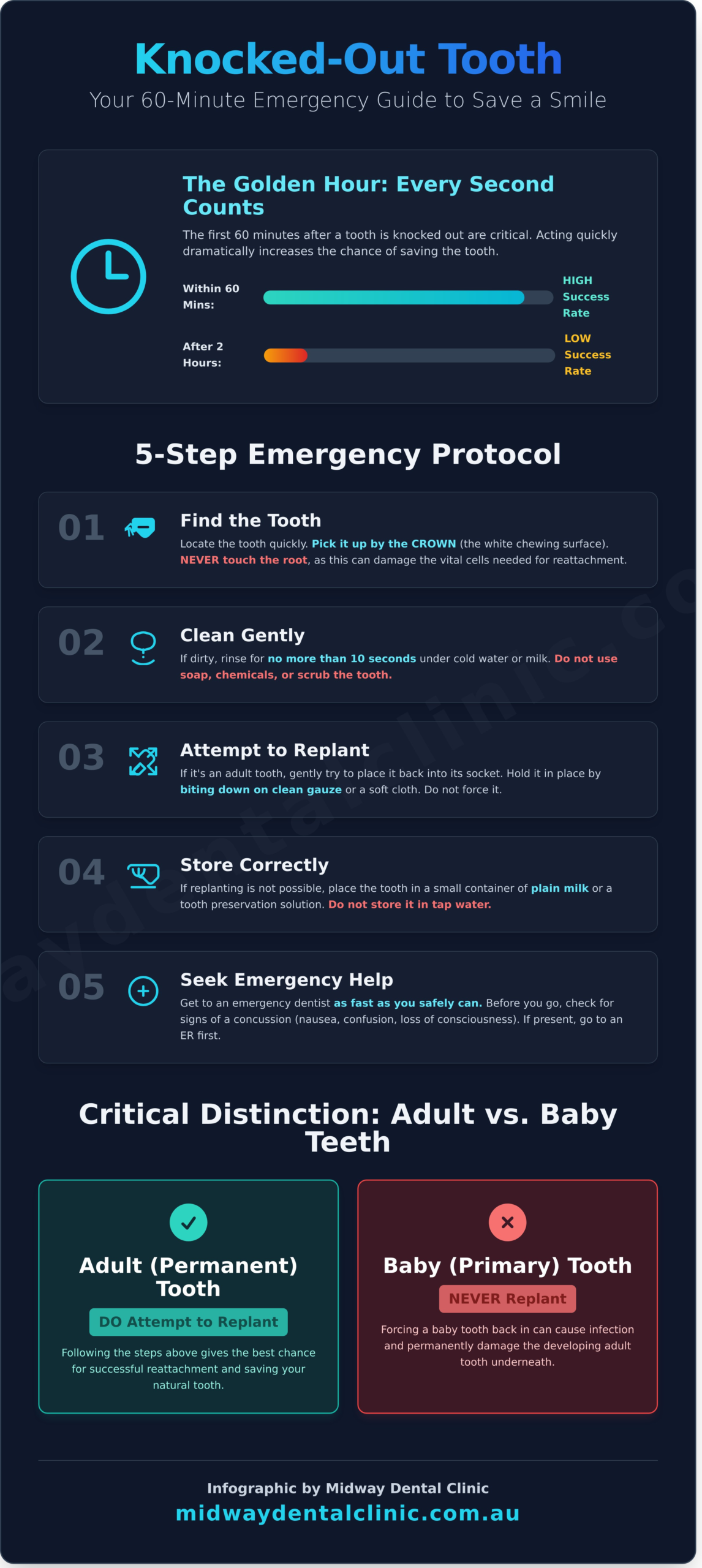
The most critical factor in saving a permanent tooth is the “Golden Hour.” This 60 minute window is the timeframe where the success rate for replanting a tooth is at its highest. Clinical data suggests that teeth replanted within 30 to 60 minutes have a significantly better chance of long-term survival. If you wait longer than two hours, the delicate cells on the root surface begin to die, making it much harder for the tooth to reattach to the bone. Every minute counts, so you must act with purpose and speed.
Before focusing entirely on the dental injury, check for signs of more serious trauma. If the person has lost consciousness, feels nauseous, or seems confused, they may have a concussion. In these cases, you should visit an emergency room immediately. If there are no signs of head trauma, your next step is to call an emergency dentist. Our Ryde clinic prioritizes dental trauma cases to ensure you receive professional guidance the moment you need it.
The 5-Step Emergency Protocol
Following a clear plan helps you stay focused during a crisis. If you are unsure about a knocked out tooth what to do, follow these five steps immediately:
- Find the tooth: Locate the tooth quickly. Always pick it up by the crown, which is the white chewing surface. Never touch the root, as this can damage the living cells needed for reattachment.
- Clean gently: If the tooth is visibly dirty, rinse it for no more than 10 seconds under cold running water or milk. Don’t use soap, chemicals, or scrub the tooth.
- Attempt replanting: Try to place the tooth back into its original socket. Hold it in place by gently biting down on a clean piece of gauze or a soft cloth.
- Store correctly: If the tooth won’t fit back into the socket, don’t force it. Place it in a small container of plain milk or a specialized tooth preservation solution. Do not store it in plain tap water.
- Seek help: Get to our clinic as fast as you safely can. We provide a welcoming environment to make you feel at ease during this urgent visit.
Adult Teeth vs. Baby Teeth: A Critical Distinction
It is essential to identify if the lost tooth is a primary (baby) tooth or a permanent (adult) tooth. You should never attempt to replant a knocked-out baby tooth. Pushing a primary tooth back into the gum can cause serious infection or physical damage to the permanent adult tooth that is still developing underneath the surface. This could lead to long-term issues with the child’s bite or the appearance of their future smile.
If your child experiences this type of injury, keep the tooth and bring it with you to see a paediatric dentist in Sydney. We focus on children’s dental care and will ensure the area is clean and that no fragments remain in the socket. Our family-focused approach ensures your little one feels safe and comfortable throughout the examination. If you have a dental emergency, call Midway Dental Clinic right away to book an urgent appointment and let our experienced team protect your family’s health.
How to Handle and Preserve a Knocked-Out Permanent Tooth
A knocked-out tooth, known clinically as an avulsion, is one of the most serious dental emergencies we see at Midway Dental Clinic. It occurs when a tooth is completely displaced from its bony socket due to a physical impact. While this is a stressful experience, our gentle and caring team wants you to know that a tooth can often be saved if you act quickly. The secret to a successful outcome lies in the health of the periodontal ligament (PDL) cells. These tiny, living fibres cover the root and are responsible for reattaching the tooth to your jawbone. If these cells die, the body will reject the tooth, making a permanent replacement like a dental implant necessary.
When you are faced with a knocked out tooth what to do first is often a matter of instinct, but your first move should be cautious. Always pick up the tooth by the crown, which is the white part you use for chewing. The number one mistake people make is grabbing the tooth by the root. Touching the root damages the delicate PDL cells and introduces bacteria that can lead to infection. If the tooth is dirty, hold it by the crown and rinse it under cold running water for no more than 10 seconds. You should never use soap, hand sanitiser, or any household chemicals. Avoid scrubbing the tooth or trying to scrape off any bits of tissue, as these are the very components needed for healing.
To save a knocked-out tooth, you must keep it moist and protected during the trip to our Ryde clinic. If you can, try to gently place the tooth back into its socket and have the patient bite down on a clean piece of gauze to hold it steady. If that isn’t possible, you need a safe storage medium immediately.
The Best Storage Media for an Avulsed Tooth
Cold, plain milk is the best choice for storing a tooth. It has a balanced pH level and contains proteins that provide a hospitable environment for PDL cells for about 60 minutes. If milk isn’t available, the patient’s own saliva is a reliable alternative. You can place the tooth inside the patient’s cheek, provided they are old enough not to swallow it. For families who are active in sports, we suggest keeping a commercial storage solution, such as a “Save-A-Tooth” kit, in your first-aid bag. These kits use a pH-balanced salt solution that can keep a tooth viable for up to 24 hours, though immediate professional care is still vital.
What to Avoid: Common Myths Debunked
There are several common misconceptions that can ruin the chances of a successful reattachment. You should never store a tooth in plain tap water. Water is hypotonic, which means it causes the living cells on the root to swell and burst. Similarly, wrapping a tooth in a dry tissue or cloth will kill the cells within minutes. We also see patients who have tried to “clean” the tooth with alcohol or antiseptic wipes. These substances are too harsh and will instantly destroy the PDL fibres.
Timing is the most critical factor in a dental emergency. A 2017 study by the International Association of Dental Traumatology indicates that the success rate for replantation drops by 50% if the tooth remains out of the mouth for more than 60 minutes. You should never wait until the morning to seek help. Our emergency dental team is always ready to provide the urgent care your family needs to keep your smiles bright and healthy. Knowing exactly a knocked out tooth what to do in those first few minutes makes all the difference for your long-term oral health.
At the Clinic: What to Expect During Your Emergency Visit
When you walk through our doors with a dental emergency, our first priority is to make you feel safe and comfortable. Our gentle and caring team understands that a dental injury is a frightening experience for both children and adults. We immediately focus on pain management to help you relax. Whether it is through local anaesthesia or a calming environment, we ensure that your comfort comes first before we begin any clinical work. We treat every patient like a member of our own family, ensuring you receive the same level of empathy we would want for ourselves.
The diagnostic process starts with a thorough clinical examination of the empty socket and the surrounding area. Our dentists use advanced digital X-rays to check for any hidden fractures in the jawbone or damage to the roots of neighbouring teeth. This step is essential because it tells us if the bone is healthy enough to support the replanted tooth. Understanding a knocked out tooth what to do involves more than just the immediate rescue; it requires a professional assessment of the entire mouth to prevent long-term complications.
Once we’ve confirmed the area is ready, we’ll begin the replantation process. We gently clean the tooth and the socket before carefully placing the tooth back into its original position. According to the American Association of Endodontists guide to saving a knocked-out tooth, the speed of this process is the most significant factor in a successful outcome. To keep the tooth stable while the surrounding tissues heal, we apply a flexible splint. This involves bonding a thin, unobtrusive wire to the injured tooth and the healthy teeth on either side, acting much like a temporary brace.
Follow-up care is a vital part of our restorative care philosophy. You’ll typically return to see us after 7 to 14 days so we can remove the splint and check the healing progress. We’ll then monitor the tooth’s vitality through regular check-ups over the next six months. These visits allow us to ensure the root is integrating correctly with the bone and that no infection is developing deep within the gums. We’re committed to helping you keep your natural smile for a lifetime.
Managing Dental Anxiety During Trauma
We know that accidents are stressful, so we’ve designed our practice to be a haven for nervous patients. Our team takes the time to listen to your concerns and provide clear, simple explanations of your treatment options. If you’re feeling overwhelmed, we offer various sedation levels to keep you as comfortable as possible. By keeping you informed and relaxed, we empower you to make the best decisions for your general dentistry needs even during a crisis.
Finding an Emergency Dentist in Sydney
In a crisis, you don’t have time to search far for help. Choosing an accredited clinic for urgent trauma is essential for the best results. If you need an emergency dentist in Sydney, our team is ready to provide immediate assistance. When you call our Ryde or Ashfield clinics, please tell us exactly when the injury happened and how you’ve stored the tooth. Knowing a knocked out tooth what to do in those first few minutes helps our team prepare for your arrival. Contact us immediately on (02) 9807 2909 to book your emergency appointment and let us help you save your smile.
When the Tooth Cannot Be Saved: Long-Term Restoration Options
Sometimes, even if you follow every step for a knocked out tooth what to do, the tooth simply cannot be saved. This often happens if the tooth was out of the socket for more than 60 minutes or if the root sustained significant damage during the impact. If the delicate periodontal ligaments have died, replantation won’t work. We know this news can be upsetting. Our team at Midway Dental Clinic is here to support you with a gentle and caring approach. We prioritize your comfort and help you understand that a lost tooth doesn’t mean a lost smile.
The emotional impact of losing a front tooth is significant. It can affect how you speak, eat, and feel about your appearance. We’ve helped hundreds of patients in Ryde regain their confidence through personalized recovery plans. We listen to your concerns about costs and aesthetics. We offer flexible options because we believe everyone deserves a healthy, beautiful smile. Our dentists use advanced technology to design restorations that look and feel completely natural. While the immediate focus is on a knocked out tooth what to do in the moment, your long-term health depends on a solid restoration plan.
Dental Implants: The Gold Standard for Tooth Replacement
Dental implants are the most reliable long-term solution. They don’t just fill a gap; they replace the entire structure of the tooth. An implant uses a medical-grade titanium post that acts as a new root. This is vital because it stimulates the jawbone. Without this stimulation, the bone can shrink by up to 25% in the first year after tooth loss. By choosing dental implants in Sydney, you’re investing in a solution that protects your facial structure and prevents other teeth from shifting.
- High Success Rates: Clinical data from the Australian Dental Association shows that dental implants have a success rate of 98% when maintained properly.
- Natural Look: We custom-match the porcelain crown to your existing teeth for a seamless finish.
- Timeline: The process typically involves a healing period of 3 to 6 months to ensure the implant is secure before the final tooth is attached.
Bridges and Other Alternatives
If you prefer a non-surgical option or need a faster result, a dental bridge is an effective alternative. A bridge uses the healthy teeth on either side of the gap as anchors. We place crowns on these teeth to hold a custom-made prosthetic tooth in place. This procedure is usually completed in just 2 visits. While bridges don’t prevent bone loss like implants do, they provide excellent stability and a natural appearance through our cosmetic dentistry services.
We don’t want you to leave our clinic feeling self-conscious. If you’re waiting for a permanent restoration, we provide temporary options like a dental flipper or a resin-bonded bridge. These temporary fixes ensure your smile stays intact while we work on your long-term plan. Our emergency dental care team ensures you’re never left without a functional solution. We’ll walk you through the pros and cons of each choice so you can make an informed decision for your health and budget.
Your journey to a restored smile starts with a conversation. We invite you to book an appointment with our friendly team today to discuss your restoration options in a relaxed environment.
Preventing Dental Trauma and Protecting Your Family’s Smiles
While knowing a knocked out tooth what to do is essential for any parent or athlete, preventing the injury from occurring in the first place is our primary goal. Dental trauma often happens in a split second, but the physical and financial impact can last a lifetime. At Midway Dental Clinic, we believe that proactive care is the best way to keep your family’s smiles safe and intact during weekend sports or backyard play.
Mouthguards for Sports and Active Lifestyles
Every athlete participating in contact sports should wear a professionally made mouthguard. The Australian Dental Association reports that roughly 31% of dental injuries in children are related to sports. While “boil and bite” guards from local chemists are cheap, they often provide a false sense of security. These over the counter options are frequently bulky, making it hard to breathe or speak, which leads many players to leave them in their locker instead of their mouth.
Our team provides custom-fitted mouthguards that offer superior protection by absorbing and spreading the impact of a blow. We take a precise digital impression of your teeth to ensure the guard fits snugly against your gums. This perfect fit means the guard stays in place even during a heavy collision. To keep your mouthguard in top condition, follow these simple steps:
- Rinse it with cold water or a mouthwash after every use.
- Store it in a sturdy, ventilated plastic container.
- Keep it out of direct sunlight and hot cars, as heat can distort the shape.
- Bring it to your regular appointments so we can check for wear and tear.
Your Partner in Long-Term Oral Health
Regular visits are about more than just finding cavities; they are a vital part of trauma prevention. During a dental check-up and clean in Sydney, we assess the alignment of your teeth. For example, protruding front teeth are three times more likely to suffer trauma than teeth that are correctly aligned. Identifying these risks early allows us to discuss protective strategies or orthodontic options before an accident happens.
We pride ourselves on being a gentle and caring practice that treats every patient like a member of our own family. Our clinicians use modern diagnostic tools to monitor the health of your roots and jawbone, ensuring your smile is resilient. If you or your child are starting a new sports season, it’s the perfect time to review your protective gear. We want you to enjoy your active lifestyle without the constant fear of a dental emergency.
If you haven’t had a review lately, our team is here to help. You can easily book your next visit at our Ryde dental clinic to ensure your family’s oral health is on the right track. We’ve supported the Sydney community for years with professional, empathetic care. Don’t wait for an accident to happen before thinking about your teeth. Contact us today to schedule an appointment and take a proactive step toward a lifetime of healthy, confident smiles.
Take Immediate Action to Protect Your Dental Health
Accidents happen fast, but your response can be just as quick to save your smile. Knowing for a knocked out tooth what to do in those first 60 minutes is the most important step you can take. Remember to handle the tooth by the crown only and keep it moist while you head to the clinic. At Midway Dental Clinic, we’ve provided gentle and caring emergency support to the Inner West Sydney community for over 25 years. Our accredited practice uses advanced technology to treat every patient with the highest level of professional care. We understand that dental emergencies are stressful, so we focus on making you feel at ease from the moment you walk through our doors. Whether we’re saving your natural tooth or exploring modern restoration options, your comfort is always our priority. You don’t have to face a dental crisis alone. Our experienced team is ready to help you regain your healthy, confident smile today.
Book an Emergency Appointment Now
Frequently Asked Questions
Is a knocked-out tooth a dental emergency?
Yes, a knocked-out tooth is a critical dental emergency that requires immediate attention from your emergency dentist in Ryde. To give the tooth the best chance of survival, you should aim to see a professional within 30 to 60 minutes of the injury. Our team at Midway Dental Clinic prioritises emergency cases to provide the gentle and caring support you need during such a stressful moment.
Can a tooth be put back in after 2 hours?
While it’s possible to replant a tooth after 2 hours, the success rate drops below 20 percent once it has been out of the socket for that long. The cells on the root surface begin to die quickly when they aren’t in a moist environment. If you’re wondering about a knocked out tooth what to do after this time, still bring it to us in a container of milk or saliva immediately.
What happens if you don’t find the knocked-out tooth?
If you can’t find the tooth, our team will help you explore restorative options like a dental implant or a bridge. We focus on your comfort and long term health to ensure your smile remains complete. Missing teeth can cause the surrounding teeth to shift by up to 3 millimetres over time; therefore, we recommend starting a replacement plan within 3 to 6 months to maintain your jaw structure.
How much does it cost to fix a knocked-out tooth in Sydney?
In Sydney, the cost to initially replant and splint a tooth typically ranges from A$300 to A$600 depending on the complexity of the case. If the tooth cannot be saved, a single dental implant often costs between A$4,000 and A$6,000 in the New South Wales region. We provide clear, upfront quotes and flexible payment plans to help your family manage these unexpected costs without any added stress.
Can a dentist save a tooth that has been knocked out for a long time?
It’s very unlikely for a tooth to survive if it has been out of the mouth for more than 6 hours. By this stage, the periodontal ligament cells are usually no longer viable for natural reattachment. Our experienced dentists will assess the socket and discuss modern replacement options to restore your confident smile. We’ll always listen to your concerns and find the most gentle solution for your specific situation.
What should I do if my child knocks out a baby tooth?
You shouldn’t try to put a baby tooth back into the socket because it can damage the permanent tooth growing underneath. Instead, keep the area clean and bring your child to see us for a paediatric dental assessment. We see many children at our family-friendly clinic and will check if a space maintainer is needed to keep their future smile straight and healthy.
Will I need a root canal after my tooth is replanted?
Most adults will need a root canal treatment within 7 to 14 days after a tooth is replanted. This is because the blood supply to the tooth is severed during the injury, which leads to the death of the inner pulp. Performing this procedure early prevents infection and helps save the tooth structure. We use advanced technology to make this process as comfortable and anxiety-free as possible.
How do I know if the replanted tooth is healing correctly?
You’ll know the tooth is healing if it feels stable in the socket and the surrounding gum tissue remains a healthy pink colour. We’ll schedule follow-up appointments at 2 weeks, 4 weeks, and 3 months to monitor the progress with digital X-rays. If you notice any darkening of the tooth or persistent swelling, please call our friendly team immediately so we can provide the necessary care. Book an appointment today to ensure your smile stays healthy and bright.