

Does the thought of the dental crown procedure bring up a few questions or a little bit of anxiety? If so, you’re not alone. It’s completely normal to worry about discomfort, wonder how many appointments you’ll need, or feel concerned about whether your new crown will look and feel natural. Here at our clinic, we hear these concerns from our patients, and our first priority is always to ensure you feel comfortable, cared for, and completely informed.
We believe that understanding the process is the first step towards a relaxed and positive experience. That’s why we’ve created this gentle, step-by-step guide. We will walk you through everything, from your initial consultation to the final placement of your beautiful new crown. Our goal is to take the mystery out of the treatment, so you know exactly what to expect at each visit and can feel confident about restoring the strength and appearance of your smile.
First, Why Might You Need a Dental Crown?
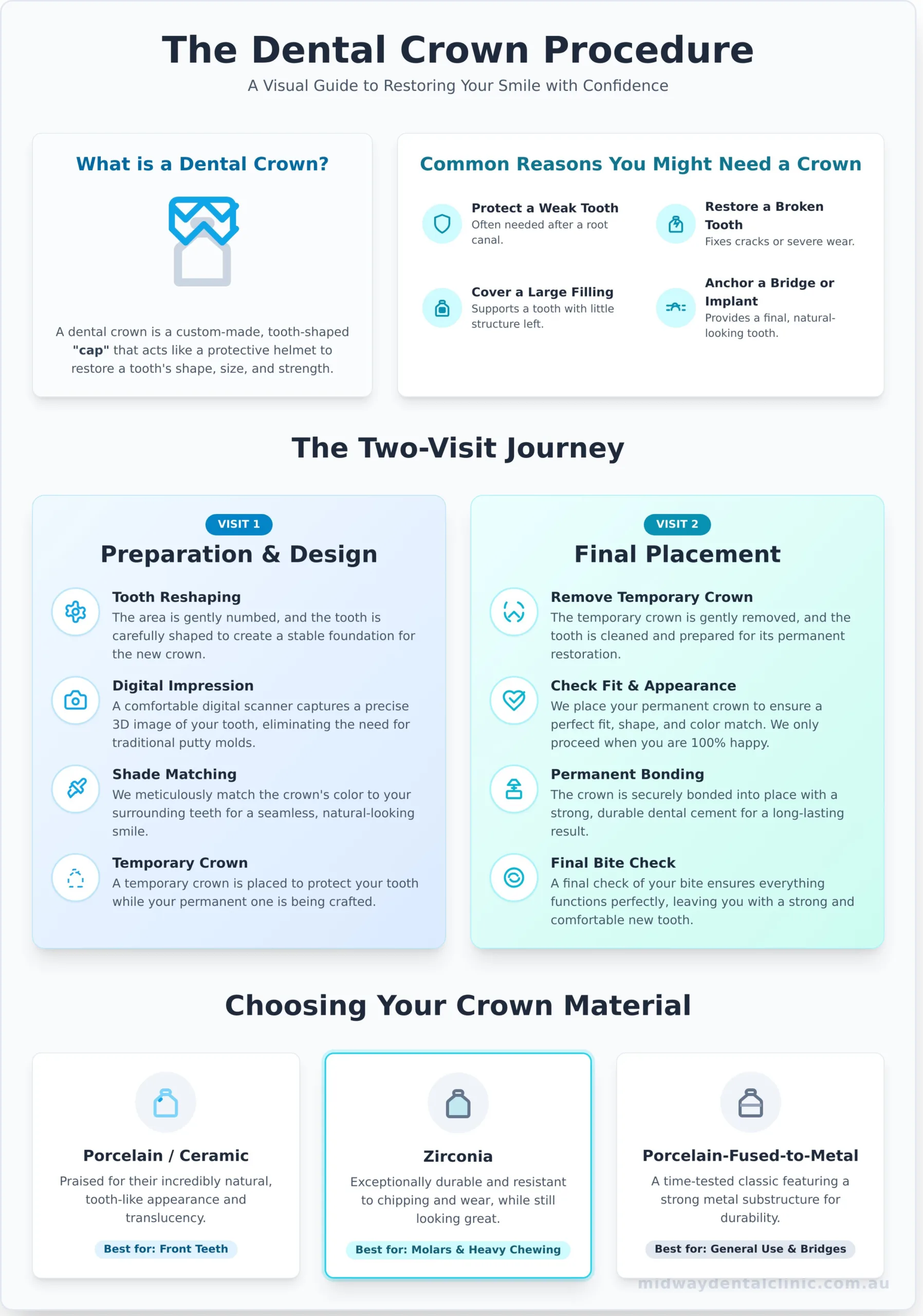
If you’ve heard your dentist mention a “crown,” you might be picturing something other than a dental treatment. In the simplest terms, a dental crown is a custom-made, tooth-shaped “cap” that is placed over a tooth. Think of it like a protective helmet for a tooth that has become weak or damaged. Its main job is to cover the tooth to restore its shape, size, strength, and improve its overall appearance. By creating a new outer surface, a crown protects the vulnerable tooth underneath from further harm.
This treatment is a cornerstone of restorative dentistry, designed to bring a tooth back to full function so you can eat, speak, and smile with complete confidence. While we are here to guide you through every step, you can always learn more about dental crowns and their technical aspects from trusted resources.
Common Scenarios for a Dental Crown
At our Ryde dental clinic, we recommend crowns for several common reasons, all with the goal of preserving your long-term oral health. You may be a candidate for a crown if you need to:
- Protect a weak tooth from breaking, which is often necessary after a root canal treatment leaves a tooth more fragile.
- Restore a tooth that is already broken, cracked, or has been severely worn down over time.
- Cover and support a tooth with a large filling where there isn’t much of the natural tooth left.
- Hold a dental bridge securely in place or provide the final, natural-looking tooth for a dental implant.
The Goal: Saving Your Natural Tooth
It’s important to see a crown as more than just a cosmetic fix-it is a key restorative treatment. The primary goal of the dental crown procedure is often to save a natural tooth that might otherwise need to be extracted. By protecting it from daily pressures, a crown can be the best way to preserve your tooth and maintain the natural structure of your smile.
We want to reassure you that this is a very routine and highly successful treatment. Our gentle and caring team is dedicated to making your experience comfortable and stress-free, ensuring your tooth is restored to its full health and beauty for many years to come.
Your Dental Crown Journey: A Two-Visit Process
The complete dental crown procedure is a calm and predictable journey that typically unfolds over two main appointments at our clinic. We believe in making every step clear and comfortable for you. The first visit is all about preparing your tooth and designing your future smile, while the second is dedicated to fitting your beautiful, permanent crown. The time between these visits allows our skilled dental technicians to meticulously craft a crown that is uniquely yours. At every stage, our gentle and caring approach ensures you feel at ease.
Visit 1: Preparing Your Tooth and Taking Impressions
Our first priority is always your comfort. We begin by gently numbing the area around the tooth to ensure the entire experience is as comfortable as possible. Next, we carefully reshape the tooth, removing any damaged areas and creating a stable foundation for the crown to sit on. To create a perfect model, we take an impression. Many patients are relieved to hear we often use a modern digital scanner-a small, comfortable wand that captures a precise 3D image of your tooth, eliminating the need for traditional putty. We then meticulously match the shade of your crown to your surrounding teeth for a seamless, natural look.
The Temporary Crown: Your Tooth’s Protector
While your permanent crown is being custom-made, we won’t leave your prepared tooth exposed. We will place a temporary crown to protect it, allowing you to eat and speak normally. This temporary restoration is secured with a gentle adhesive. To keep it safe until your next visit, we recommend a few simple precautions:
- Avoid chewing very sticky foods like caramels or hard lollies on that side.
- Be gentle when flossing, pulling the floss out to the side rather than straight up.
- If it feels unusual, please don’t hesitate to call us.
Visit 2: Placing Your Permanent, Custom-Made Crown
Welcome back! On your second visit, we start by gently removing the temporary crown. We will then place your new, permanent crown to check its fit, shape, and colour. This is a collaborative step, and we only proceed when you are completely happy with how it looks and feels. For an overview of what to expect during this fitting, many patients find resources like this step-by-step guide to the dental crown procedure from the Cleveland Clinic very helpful. Once we confirm the perfect fit, we securely bond the crown into place with a strong dental cement. A final check of your bite ensures everything feels comfortable and functions perfectly, leaving you with a strong, healthy, and beautiful new tooth.
Choosing Your Crown: Materials and Modern Technology
One of the most important steps in your dental crown procedure is choosing the right material for your new tooth. This isn’t a one-size-fits-all decision; the best choice depends on the tooth’s location, the biting forces it endures, and your personal aesthetic goals. We are here to gently guide you through the options, helping you select a crown that restores your tooth’s strength and gives you a beautiful, confident smile. While we’ll discuss everything in person, you can find helpful answers to your questions about dental crowns online to familiarise yourself with the basics before your visit.
Common Types of Dental Crown Materials
Thanks to modern dentistry, you have several excellent, high-quality materials to choose from, each with unique benefits. We will always recommend the one best suited to your specific needs.
- Porcelain or Ceramic: Praised for their incredibly natural, tooth-like appearance, these crowns are a popular choice for front teeth where aesthetics are a top priority. They can be colour-matched to blend seamlessly with your smile.
- Zirconia: This is a type of high-strength ceramic that is both exceptionally durable and visually appealing. Its resistance to chipping and wear makes it an ideal choice for molars that handle heavy chewing forces.
- Porcelain-Fused-to-Metal (PFM): A time-tested classic, these crowns feature a strong metal core for durability, covered with a layer of tooth-coloured porcelain for a natural look.
- Gold or Metal Alloys: Known for their outstanding strength and longevity, gold and metal alloys are extremely kind to opposing teeth. They are often recommended for molars in the very back of the mouth where they are not visible.
How Our Technology Creates a Better Experience
At Midway Dental Clinic, we invest in state-of-the-art technology because it makes your care more comfortable, precise, and efficient. We’ve replaced old-fashioned, goopy impression putty with quick and comfortable digital impressions. A small, handheld scanner captures a highly detailed 3D image of your tooth in minutes, ensuring a perfect model without any mess or discomfort.
This digital scan is then used with CAD/CAM (Computer-Aided Design/Computer-Aided Manufacturing) technology. This allows our skilled dentists and technicians to design your crown with incredible precision. The result is a superior fit that feels natural, integrates perfectly with your bite, and is built to last for years to come.
Caring for Your New Crown: Recovery and Long-Term Success
Congratulations on completing your dental crown procedure! You’ve taken a wonderful step towards restoring your tooth’s health and appearance. Caring for your new crown is simple and straightforward, and with a little attention, it will serve you well for many years. Here is what you can expect during recovery and how to ensure its long-term success.
Immediately After Your Procedure
It’s perfectly normal to experience some temporary changes as you adjust to your new crown. You might notice mild sensitivity to hot or cold foods and drinks for a few days. We also recommend eating soft foods and chewing on the opposite side of your mouth for the first 24 hours. Your new crown may feel slightly different to your tongue at first, but rest assured, this feeling will quickly fade as your mouth adapts.
Long-Term Care for Your Crown and Gums
Think of caring for your crown as caring for your natural teeth. The key to its longevity is excellent oral hygiene, which also protects the gum tissue around the crown and the tooth underneath. We recommend these simple habits:
- Brush and Floss Daily: Gently brush twice a day and be sure to floss around the base of the crown to remove plaque and prevent gum disease.
- Avoid Damaging Habits: Your crown is strong, but not indestructible. Avoid chewing on very hard objects like ice, popcorn kernels, or pen caps to prevent chipping or cracking.
- Attend Regular Check-ups: Routine visits are essential. During a dental check-up & clean, we can monitor your crown, the underlying tooth, and your overall oral health to catch any potential issues early.
How Long Do Dental Crowns Last?
With proper care, a high-quality dental crown is a durable, long-term solution. Most crowns last between 10 to 15 years, and many can last even longer. The lifespan depends on the crown material and, most importantly, your commitment to consistent oral hygiene and regular dental visits. By following these simple care instructions after your dental crown procedure, you are making a lasting investment in your smile and health.
If you have any questions about your new crown, our gentle and caring team at Midway Dental Clinic is always here to help. Contact us anytime.
Your Questions About the Dental Crown Procedure Answered
It’s completely normal to have questions before any dental treatment. We believe that understanding the process is the first step towards feeling calm and confident in your care. At Midway Dental Clinic, we are always here to listen to your concerns. To help you feel more at ease, we’ve answered some of the most common questions we hear about the dental crown procedure.
Is the Dental Crown Procedure Painful?
Your comfort is our absolute top priority. Before we begin, we ensure the tooth and the entire surrounding area are completely numb using a local anaesthetic. You should not feel any pain during the treatment, only some minor sensations of pressure or vibration. After your appointment, as the numbness wears off, you might experience some mild tenderness, which is easily managed with over-the-counter pain relief.
Are There Alternatives to a Dental Crown?
While a crown is often the best solution for protecting a compromised tooth, other options may be suitable in specific situations. These can include:
- Inlays or Onlays: These are like large fillings used when a tooth is damaged but doesn’t require the full coverage of a crown.
- Veneers: These are a cosmetic option for the front teeth, covering only the forward-facing surface.
However, when a tooth is significantly cracked, weakened by a large filling, or has had root canal therapy, a crown provides superior strength and long-term protection. If a tooth is already missing, a bridge or a dental implant would be the recommended solution. In cases of severe, irreparable damage, our emergency dentist may advise that an extraction is the healthiest option.
How Much Does a Dental Crown Cost?
The cost of a dental crown in Australia can vary depending on factors like the material used (e.g., porcelain, ceramic, or gold alloy) and the complexity of your individual case. We are committed to complete transparency. Before any treatment begins, we will provide you with a detailed treatment plan and a clear, upfront quote. We will discuss all the material options with you to find a solution that fits both your clinical needs and your budget. The best way to get an accurate cost is to schedule a consultation with our friendly team.
Your Path to a Stronger, More Confident Smile
We hope this guide has made the journey to getting a dental crown feel much clearer and less daunting. Understanding that it’s typically a straightforward two-visit process designed to protect and strengthen your tooth can bring great peace of mind. With proper aftercare, your new crown is a lasting investment in your oral health and confidence.
At Midway Dental Clinic, your comfort is our priority. We combine a gentle, patient-focused approach with advanced technology to ensure the entire dental crown procedure is a smooth and positive experience. With over 25 years of trusted care in our community, our team is here to listen to your concerns and guide you every step of the way.
If you feel a crown could be the right solution for you, we warmly invite you to take the next step. Ready to restore your smile? Book a gentle consultation at our Ryde or Ashfield clinic. Let us help you get back to smiling with complete confidence.
Frequently Asked Questions About the Dental Crown Procedure
Will my dental crown look fake or unnatural?
We understand that you want your smile to look completely natural. Thanks to modern materials like porcelain and zirconia, we can create a crown that looks, feels, and functions just like your own teeth. Our experienced dentists take great care to custom-match the colour, shape, and size of your crown to your surrounding teeth. The final result is a seamless, beautiful restoration that blends in perfectly, giving you a confident and healthy smile.
How long does each appointment for a dental crown take?
The dental crown procedure is typically completed over two comfortable appointments. Your first visit, which involves preparing the tooth and taking impressions, usually lasts between 60 to 90 minutes. Your second appointment, where we fit and bond your permanent crown, is often a bit shorter, around 30 to 60 minutes. We always take the time to ensure you’re at ease and the fit is perfect, so you can leave our clinic feeling comfortable and confident.
What happens if my temporary crown falls off?
There’s no need to panic if your temporary crown comes loose, but it is important to contact us right away. The temporary crown protects the prepared tooth underneath, so we’ll want to see you as soon as possible to re-cement it. In the meantime, you can often find temporary dental cement at a local pharmacy to hold it in place. Please give our friendly team a call, and we will guide you on the best next steps to take.
Can you get a cavity under a dental crown?
Yes, it is possible for a cavity to form on the tooth underneath a crown. Decay typically starts at the margin, which is the line where the crown meets your natural tooth. This is why maintaining excellent oral hygiene is so important. Consistent brushing and flossing help prevent plaque from building up around this margin, protecting both your crown and the underlying tooth for many years to come and ensuring your smile stays healthy.
Is there any special way I need to brush or floss around my new crown?
Caring for your new crown is just like caring for your natural teeth! We recommend brushing twice daily with a soft-bristled toothbrush and flossing at least once a day. When flossing around the crown, it’s best to gently slide the floss down and then pull it out from the side, rather than pulling it back up. This gentle technique helps protect the seal of the crown and keeps the surrounding gums healthy, ensuring your beautiful restoration lasts.
Why can’t I just get a large filling instead of a crown?
This is a great question we hear often. While a filling is excellent for repairing smaller areas of decay, it doesn’t add strength to the tooth. When a tooth has a very large filling, a crack, or has had root canal therapy, it becomes weak and prone to fracturing. A dental crown covers and protects the entire tooth, acting like a helmet. This provides the necessary strength to prevent a future break and preserve your tooth for the long term.